First of all, I have to admit one thing: I am not a JPII generation catholic. I didn't grow up listening or knowing much about our late Pope John Paul II. That is not because I hate him, absolutely not. It was because of how little Catholic material was available at my hometown during the period of me growing up in faith. But, I have to give him a credit. Because of his death, I dug deeper into my Catholic faith, only to find a plethora of an immovable and a universal truth.
I learned more about Papa JPII through his writing (the first one would be: Crossing the Threshold of Hope), the narrated movie of his (Witness to Hope, based on a book with the same title by George Weigel), the stories of how Pope JPII touched so many lives of young people (definitely recommend this book) and the latest from his series of sermon from 1979-1984: Theology of the Body.
I regretted the fact that I grew up not knowing who this late great JPII was and after the election of the new pope, I wouldn't repeat the same mistake twice.
So, I am one, among many, who can humbly say: "I am the BXVI generation Catholic."
BXVI is known as a "scholar pope." Being a professor for 13 years, archbishop for 5 years, and a prefect of the congregation of the doctrine of faith for 24 years shaped the intellectual character of our current pope.
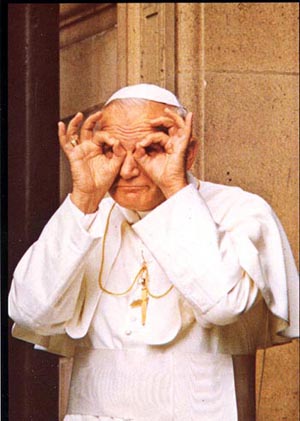
Moreover, rather than becoming a great actor (like Pope JPII with his gestures in the one with Bono or the one with his eyes), Pope BXVI challenges us to listen to his voice.
With that introduction, I would like to highlight the speeches that Pope BXVI has given during his visit to French last week.
In his first speech to Paris' cultural community at the College des Bernardins, Pope Benedict shared and gave a full lecture on two things: the origins of western theology and the roots of European culture.
He began by imploring the audience with the significance of the place where they met: a place that was built by St. Bernard of Clairvaux, the renewer of the Western monasticism. The goal of monasticism, Pope Benedict said, was "querere Deum" (to seek God).
He expanded this by trying to explain the significance of "The Word". The Word did not lead us to the path of a purely individual path of mystical immersion, Pope Benedict said, "but to the pilgrim fellowship of faith".
And once again, a further step is needed. We ourselves are brought into conversation with God by the word of God. The God who speaks in the Bible teaches us how to speak with him ourselves. Particularly in the book of Psalms, he gives us the words with which we can address him, with which we can bring our life, with all its highpoints and lowpoints, into conversation with him, so that life itself thereby becomes a movement towards him.
The Bible, Pope Benedict said, "is not simply one book but a collection of literature, which came into being in the course of more than a thousand years and in which the inner unity of the individual books is not immediately recognizeable."
He explained why scripture cannot be taken only by the historical and literacy perspective. Pope says, "Scripture requires exegesis, and it requires the context of the community in which it came to birth and in which it is lived. This is where its unity is to be found, and here too its unifying meaning is opened up."
After fully describing what "ora (prayer)" is really all about, he explained the idea of work (or in Latin: Labora).
He first started with the idea of the Greek world on work:
In the Greek world, manual labour was considered something for slaves. Only the wise man, the one who is truly free, devotes himself to the things of the spirit; he views manual labour as somehow beneath him, and leaves it to people who are not suited to this higher existence in the world of the spirit.
He then contrasted it with the Jewish idea of work:
The Jewish tradition was quite different: all the great rabbis practised at the same time some form of handcraft. Paul, who as a Rabbi and then as a preacher of the Gospel to the Gentile world was also a tent-maker and earned his living with the work of his own hands, is no exception here, but stands within the common tradition of the rabbinate.
With that, Pope BXVI then spoke about Christian work ethics:
Christians, who thus continued in the tradition previously established by Judaism, must have felt further vindicated by Jesus’s saying in Saint John’s Gospel, in defence of his activity on the Sabbath: “My Father is working still, and I am working” (5:17). The Graeco-Roman world did not have a creator God; according to its vision, the highest divinity could not, as it were, dirty his hands in the business of creating matter. The “making” of the world was the work of the Demiurge, a lower deity. The Christian God is different: he, the one, real and only God, is also the Creator. God is working; he continues working in and on human history. In Christ, he enters personally into the laborious work of history. “My Father is working still, and I am working.” God himself is the Creator of the world, and creation is not yet finished. God is working. Thus human work was now seen as a special form of human resemblance to God, as a way in which man can and may share in God’s activity as creator of the world. Monasticism involves not only a culture of the word, but also a culture of work, without which the emergence of Europe, its ethos and its influence on the world would be unthinkable. Naturally, this ethos had to include the idea that human work and shaping of history is understood as sharing in the work of the Creator, and must be evaluated in those terms. Where such evaluation is lacking, where man arrogates to himself the status of god-like creator, his shaping of the world can quickly turn into destruction of the world.
(emphasis mine)
After wrapping up his speech on the phrase that St. Benedict of Nursia coined, "ora et labora," he went back to his first point, "Querere Deum". Then, reminding the great nations of French (and in general: Europe) that, "God has truly become for many the great unknown." Concluding his speech, he reminded French that, "What gave Europe’s culture its foundation – the search for God and the readiness to listen to him – remains today the basis of any genuine culture."
In one sentence, "To the World of Culture: "Seek God""


No comments:
Post a Comment